Compact or Full-Size? Picking Your First Pistol
By AGO
October 12, 2026
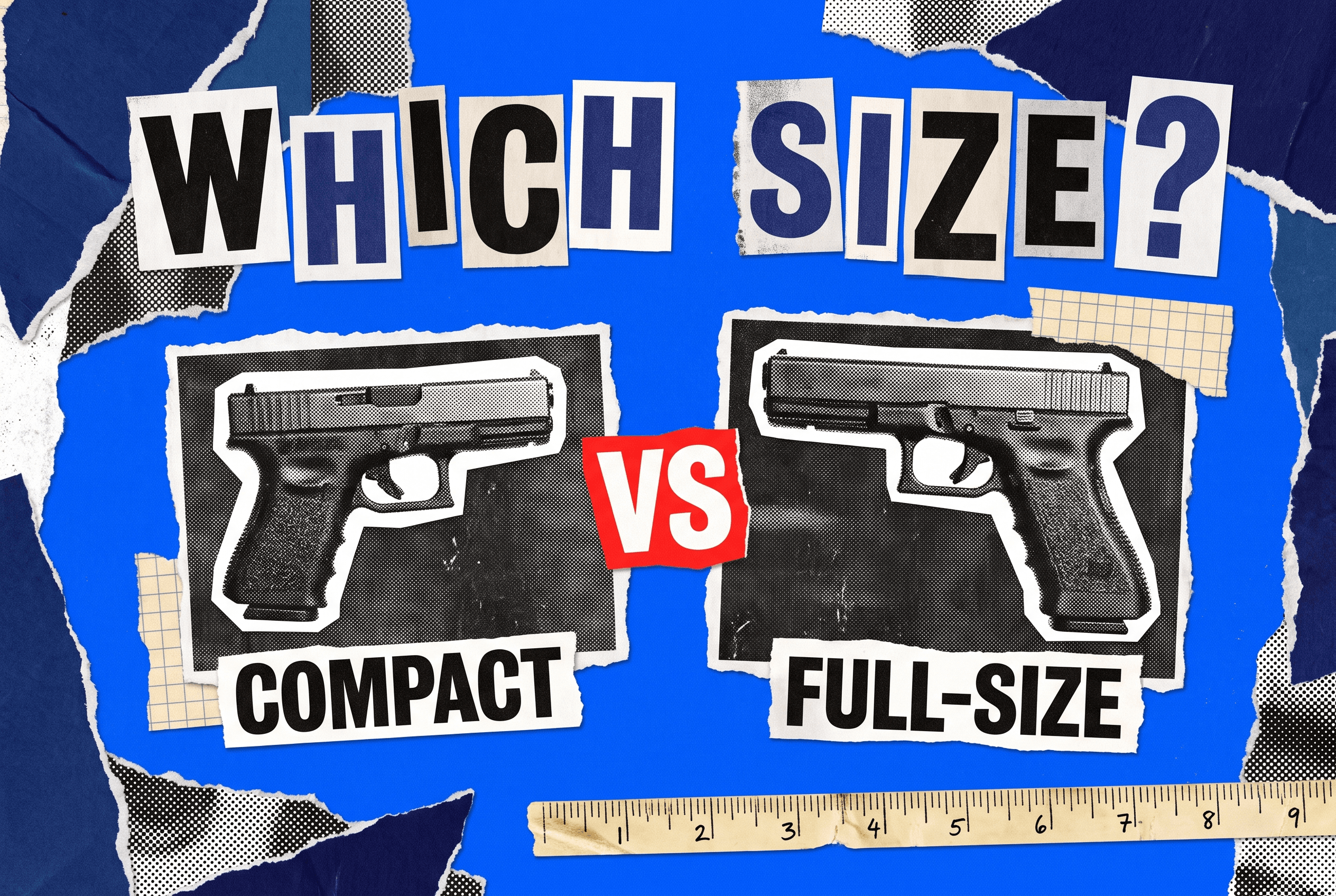
A compact and a full-size pistol in the same caliber differ by about half an inch of grip, half an inch of barrel, and two rounds. That's close to the whole story, and it's a lot less than most people expect when they're standing at a counter looking at both.
The two pistols in front of you look close enough to identical that the only honest question is what changes when you pick one up, and nobody behind the glass has time to measure it for you. Most of what gets written about this choice is aimed at people who already carry every day, which is a different problem from the one you're solving.
American Gun Owners built this guide around the figures the manufacturers publish, because the adjectives everyone else reaches for leave you no better off. If you are still working out which handgun to begin with, our guide to picking a first handgun covers that ground. Size is two measurements doing two different jobs.
Key takeaways
-
In one manufacturer's own 9mm line, a compact gives up 0.43 inch of grip height to the full-size model.
-
Overall width is identical between those two at 1.34 inch, and slide width holds at 1.00 inch across all three size classes.
-
The compact carries two fewer rounds than the full-size, and the subcompact carries seven fewer.
-
Grip height is the measurement that decides whether a pistol hides under clothing.
-
Slide and barrel length are what stretch the sight radius and steady the shot.
The short version
| If your first pistol is going to live at home, a full-size or a compact will both serve you well. If you plan to carry it every day, start compact, and measure the grip rather than the slide. |
|---|
What is the actual difference between a compact and a full-size pistol?
A compact gives up about half an inch of grip and half an inch of barrel to a full-size in the same caliber, and it isn't any narrower. Everything else about the two is close enough that you'd struggle to tell them apart in a photograph without something next to them for scale.
Glock publishes complete technical data for its Gen5 line, and the G17, G19 and G26 are the same 9x19 pistol built on three frame sizes, which makes them a clean way to see what a size class actually costs. Overall width is identical between the full-size G17 and the compact G19 at 1.34 inch, according to Glock's published G17 Gen5 technical data and G19 Gen5 technical data. The numbers below come straight off those pages.
| Measurement | Full-size (G17 Gen5) | Compact (G19 Gen5) | Subcompact (G26 Gen5) |
|---|---|---|---|
| Overall length | 7.95 inch | 7.28 inch | 6.42 inch |
| Slide length | 7.32 inch | 6.85 inch | 6.26 inch |
| Barrel length | 4.49 inch | 4.02 inch | 3.43 inch |
| Height including magazine | 5.47 inch | 5.04 inch | 4.17 inch |
| Overall width | 1.34 inch | 1.34 inch | 1.30 inch |
| Slide width | 1.00 inch | 1.00 inch | 1.00 inch |
| Weight, loaded magazine | 33.33 oz | 30.16 oz | 26.07 oz |
| Standard magazine capacity | 17 rounds | 15 rounds | 10 rounds |
Read across the width row and you'll see the thing most first-time buyers get wrong. Going from the full-size to the compact changes the width by nothing at all, and dropping to the subcompact trims it by four hundredths of an inch, per Glock's G26 Gen5 technical data. Whatever a smaller pistol is doing for you, it's doing it somewhere other than width.
The rows that do move are height and length. Grip height falls 0.43 inch from full-size to compact and another 0.87 inch to the subcompact, and barrel length falls 0.47 inch and then 0.59 inch. Those two measurements are where the size classes actually live. If you haven't settled on a pistol at all yet, our guide to pistols, revolvers and shotguns is the step before this one.
The Grip-and-Slide Rule
Grip height decides whether a pistol hides, slide length decides how steadily it shoots, and width changes almost nothing between the classes. Separating those three turns a vague question about size into two specific ones you can answer about your own week.
The grip is the part that sticks out from your body and catches on a shirt, so grip height predicts whether anyone notices. The slide and barrel put distance between the front and rear sights, and more distance there makes small aiming errors show up smaller at the target. Width sits almost still across the range, so it drops out of the decision entirely.
Here's the whole thing in one sentence you can carry into a store: going from a full-size to a compact costs you about half an inch of grip and two rounds, and it doesn't make the pistol any narrower.
Those two measurements pull in opposite directions, so knowing which one you care about more is most of the decision, and that depends on where the pistol will spend its time.
Which one is easier to shoot well?
The full-size is the steadier of the two, and the reason is sight radius and weight rather than anything about you. A longer slide spreads the sights further apart and a heavier pistol moves less when it fires, so the same shooter tends to hold a tighter group with the larger frame.
The gap is real and it's small. Across the Gen5 line, the full-size carries 0.47 inch more barrel than the compact and weighs 3.17 ounces more with a loaded magazine. Both of those work in your favor at the range, and neither is large enough to make the compact difficult. Plenty of people shoot a compact perfectly well and never think about it again.
Frame size is only one of the things shaping how a pistol feels when it fires. Caliber runs underneath all of this, and our guide to choosing your first-gun caliber covers how the two choices interact. They are worth making together.
Which one is easier to live with day to day?
The compact is the one that disappears under a shirt, and the grip is the part that gives a pistol away. Slide length hides easily because it points down along your leg, while the grip angles out from your body and is the piece that shows through fabric.
Half an inch of grip height sounds trivial written down and reads very differently once a pistol has been on your belt for nine hours. The subcompact exists for exactly that reason: it gives up another 0.87 inch of grip and five more rounds to buy back the last of the outline.
Carrying brings in a second set of questions about body shape, clothing and holster position that are worth their own treatment, and how concealed carry changes handgun fit goes through them properly. For the purposes of this decision, the short answer is that grip height is the number to compare, and the rest follows from it.
Most first pistols are not carry guns yet
Most people buying a handgun are buying it for personal protection or home defense, which is a different problem from carrying one every day. The size advice filling this corner of the internet assumes a reader who has already decided to carry, and that assumption quietly narrows every recommendation that follows.
NSSF's Handgun Consumer Study 2025 Edition reports that a high number of respondents cite personal protection or home defense as the primary reason for owning a handgun, and that the majority of handgun buyers usually purchase handguns at local gun stores. Reading that against a search results page written almost entirely about everyday carry is our own observation, not a finding of the study, and it's the mismatch worth naming before you shop.
A pistol that lives in the home carries no concealment requirement, which removes the only argument for the smaller frame. Our guide to a first home defense gun works through that case. If carrying is genuinely in your plans this year, the compact covers both jobs.
How do you tell which size fits your hand?
Fit is a grip question, and the Five R Fit Check settles it before size class enters the conversation at all. Reach, Wrap, Rack, Releases and Return are the five things to run through with any pistol you're considering, and they work the same way whichever frame you're holding.
Reach asks whether your trigger finger lands on the trigger without dragging the pistol sideways. Wrap asks whether your hand closes around the grip with your fingers meeting comfortably. Rack asks whether you can work the slide without a fight. Releases asks whether you can reach the magazine release and the slide stop without shifting your grip. Return asks whether the sights come back to where they started after a shot. A frame that fails Reach or Wrap is the wrong frame for you at any size.
Hand size has its own guide, and how to measure your grip walks through it with a tape measure. To start from the other end, the Find My Gun Kit quiz matches you to a complete setup legal where you live.
Picking a size you will not second-guess
The size you'll stop thinking about is the one that fits your hand and matches where the pistol will actually spend its time. Both of those are knowable in an afternoon, and neither of them requires you to have an opinion about frame classes.
Run the Five R Fit Check on whatever is in front of you, then ask where this pistol lives. A nightstand answer points you at the full-size or the compact. A belt answer points you at the compact, and grip height is the measurement to compare. Two minutes handling both at a counter beats another hour of reading, and an instructor will shortcut it further. AGO's training access connects you with instructors near you.
Whichever frame you land on, the pistol is one piece of a setup that also includes the case, the protection you wear at the range, and the first box of ammunition. The Find My Gun Kit quiz assembles that side of it around the choice you've just made.
Frequently Asked Questions
Is the Glock 19 considered compact or full-size?
The G19 is the compact in that line. Glock's published Gen5 data puts it at 7.28 inch overall with a 4.02 inch barrel and a 5.04 inch height including the magazine, against 7.95, 4.49 and 5.47 inch for the full-size G17. It sits between the full-size and the subcompact G26.
Do compact pistols have more recoil?
A compact in the same caliber weighs less with a loaded magazine, 30.16 oz against 33.33 oz across the Gen5 line, and a lighter pistol moves more when it fires. Recoil has no published specification, so the honest way to put it is that the weight and barrel difference are what you would be feeling. Most people adjust to the gap quickly.
Is a compact pistol harder to shoot accurately?
A shorter slide means a shorter distance between the sights, which makes small aiming errors show up slightly larger at the target. In practice the difference between a full-size and a compact is small enough that grip fit and practice matter considerably more. A compact that fits your hand will out-shoot a full-size that doesn't.
Can you carry a full-size pistol concealed?
People do, and the grip is the part that makes it work or fail. A full-size carries 0.43 inch more grip height than a compact, and that's the dimension that presses against a shirt. Holster choice, belt and clothing all move the outcome, so it lands on whether you'll keep doing it, which is a comfort question more than a mechanical one.
Should a first-time buyer start with a subcompact?
A subcompact gives up 1.30 inch of grip height and seven rounds against the full-size, and the shorter grip leaves less room for your hand, which usually makes it the least forgiving of the three to learn on. Starting on a compact or a full-size and moving smaller later is the gentler order. If a subcompact is the only thing that fits your hand, the Five R Fit Check will tell you.
Sources
-
National Shooting Sports Foundation, Industry Research Report: Handgun Consumer Study 2025 Edition, nssf.org
-
GLOCK, G17 Gen5 technical data, us.glock.com
-
GLOCK, G19 Gen5 technical data, us.glock.com
-
GLOCK, G26 Gen5 technical data, us.glock.com
Related
We strive to provide accurate, up-to-date information to help first-time firearm owners make informed decisions. Because laws and regulations vary and may change, always verify the requirements that apply to your location and and handle every firearm with care.