Glock vs Smith & Wesson for a First-Time Buyer
By AGO
October 26, 2026
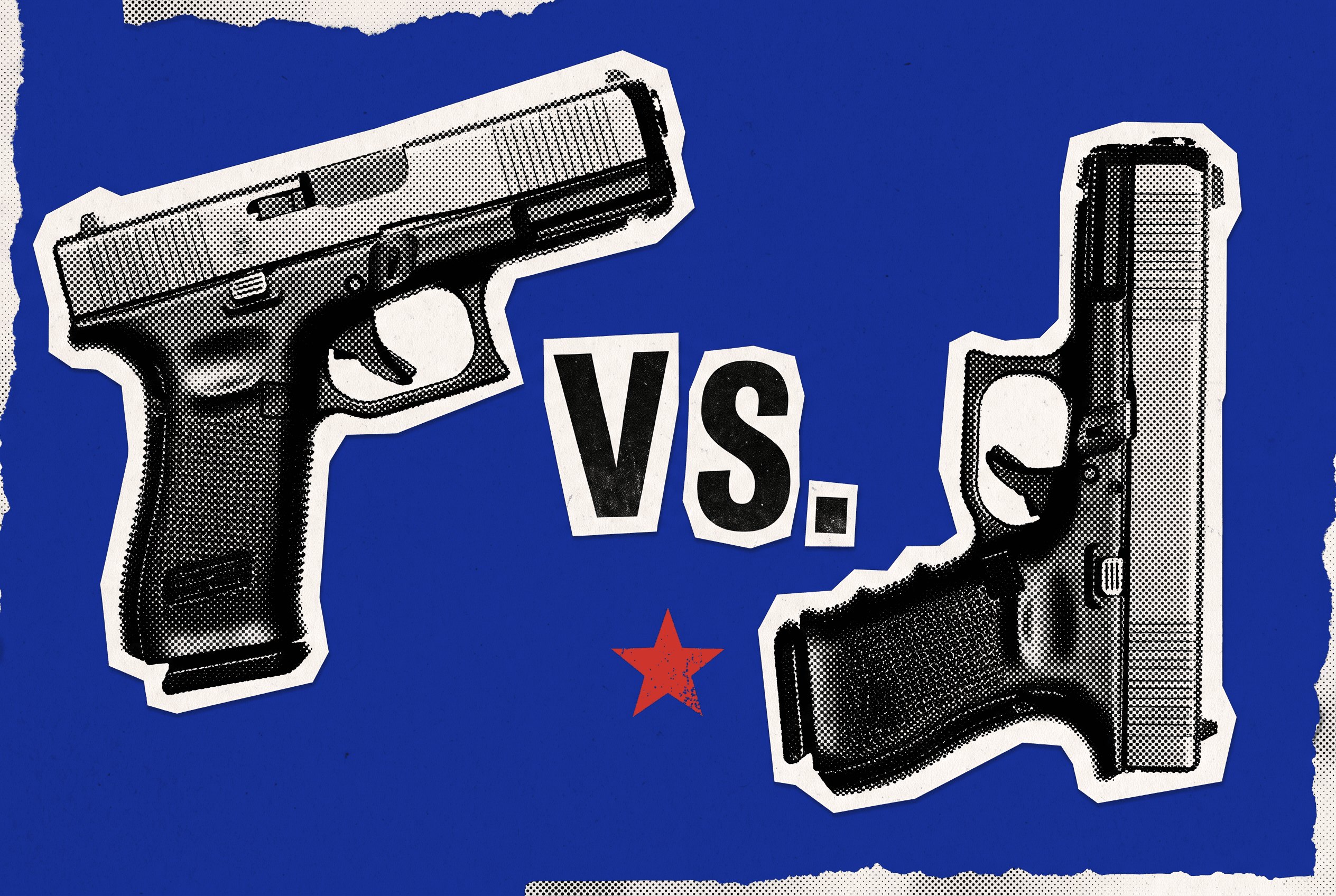
The difference that matters for a first firearm is how much each platform can be adjusted to your hand, and on that one the two are genuinely different. Everything else people argue about on this comparison is preference you cannot evaluate until you own one.
Ask this question in any room with two gun owners in it and you will get two confident answers and no way to tell which one applies to your hand. Both people are describing their own hands, which is useful information about them.
American Gun Owners sells neither platform, so what follows is read off the manufacturers' own published pages. If you have not settled on a handgun at all yet, our guide to picking a first handgun is the step before this one.
Key takeaways
-
Smith & Wesson ships four interchangeable palmswell inserts with the M&P M2.0, in sizes S, M, ML and L.
-
Glock publishes a trigger distance of 2.76 inch, and offers medium and large backstraps on Gen5.
-
That Glock trigger distance is identical on the full-size, the compact and the subcompact.
-
So a smaller Glock does not shorten the reach to the trigger, which is the opposite of what most buyers assume.
-
Both platforms adjust; one arrives with four options included and the other adjusts upward from its standard size.
The short version
| Handle both, run the same fit check on each, and let your hand decide. The published difference that matters is how many ways each one can be adjusted, rather than which badge is on the slide. |
|---|
What actually separates these two for a first-time buyer?
Both are widely available polymer-framed pistols that have been in service for decades, and the published difference that matters to a new owner is adjustability. Almost everything else on this comparison is a preference you develop after a few hundred rounds, which is not much help the week before you buy.
The arguments you will find are about trigger feel, grip angle and reliability. Trigger feel is genuinely subjective. Reliability on both platforms is the kind of thing that gets argued with anecdotes. Grip angle is real and we will come back to it, and it is also something you assess by picking a gun up rather than by reading.
What you can read, before you go anywhere, is what each manufacturer publishes about fitting the gun to a hand. That is the axis a first-time buyer can act on, and it is the one nobody argues about, because the numbers are simply printed. If the wider platform question is still open, our guide to pistols, revolvers and shotguns covers that ground.
How each one handles fit
One arrives with four grip sizes in the box and the other adjusts upward from a single standard. That is the cleanest statement of the difference, and both approaches are legitimate.
Smith & Wesson's M&P M2.0 product page states that four interchangeable palmswell grip inserts are included, in sizes S, M, ML and L, and describes them as being for hand fit and trigger reach. Glock's Gen5 specification pages publish a trigger distance figure and note that medium and large backstraps are available for Gen5 models, which adjust the grip upward from the standard size.
| Fit dimension | Smith & Wesson M&P M2.0 | Glock Gen5 |
|---|---|---|
| Fit options included in the box | Four palmswell inserts: S, M, ML, L | One standard configuration |
| Further fit options | The four included | Medium and large backstraps |
| Direction of adjustment | Down and up from the middle | Upward from the standard size |
| Published trigger-reach figure | Not published as a figure, though the inserts are stated to affect trigger reach | Trigger distance 2.76 inch |
| Published grip angle | 18 degrees | Not published on the pages read for this article |
Here is the practical version. One of them comes with four grip sizes in the box, so if your hand is between sizes, that is the one to try first. If the standard Glock grip already suits you, the backstraps are there for the other direction and you will never need them.
Why a smaller Glock does not shorten the trigger reach
Glock publishes the same trigger distance, 70 mm or 2.76 inch, on the full-size G17 Gen5, the compact G19 Gen5 and the subcompact G26 Gen5. The frame gets shorter and the reach to the trigger does not change at all.
That is worth knowing because it contradicts the most common assumption a first-time buyer makes. If your trigger finger struggles to reach cleanly, the instinct is to ask for something smaller. On this platform, smaller changes the grip height and the overall length and leaves the distance to the trigger exactly where it was.
The fix for a reach problem on that platform is the backstrap, or a different platform. Which is precisely why the four-size approach matters to anyone whose hands sit at either end of the range. Our guide to measuring your grip covers how to work out where you sit before you go.
One caution on comparing them at a counter. If the pistol you are handed has inserts or a backstrap fitted in a size that is wrong for you, you are testing the fitting rather than the platform. Ask what is on it and ask for the standard configuration if you are unsure, so the comparison is actually like for like.
Which is easier to learn on?
Whichever one fits your hand, and that is a real answer rather than a way of avoiding the question. A pistol you can reach the trigger on without shifting your grip is easier to learn on than any pistol you cannot, regardless of which company made it.
The reason this sounds like a dodge is that the question is usually asked as though one platform is objectively more forgiving. Both have been carried by large police agencies, both are used by millions of private owners, and both are commonly recommended to new shooters. The variable that changes outcomes at the individual level is fit, and fit is personal by definition.
So the useful version of the question is: which of these fits me. That has an answer, you can get it in five minutes at a counter, and no amount of reading substitutes for it.
What about the controls?
Control layout differs between the two, and a thumb safety is offered on some configurations of one platform and not on the other. Which arrangement suits you is again a hand question rather than a quality question.
What to check when you handle each one is whether you can reach the magazine release and the slide stop without rolling the gun in your hand. That is a specific, testable thing, and it is a common reason people end up preferring one platform without ever articulating why. Configurations vary within each platform too, so check the specific gun in front of you rather than the brand.
The same applies to sights, which vary by configuration on both, and to whether a given gun is cut for an optic. None of that is a brand-level difference, and treating it as one is how these comparisons go wrong.
Which one should you handle first?
Whichever the nearest counter has, because handling both back to back is the only test that settles it. Fit is comparative, and the difference between a gun that suits your hand and one that nearly does is far easier to feel in sequence than in isolation.
Ask to handle both, run the same checks on each, and pay attention to reach and grip before anything else. If one of them has grip inserts fitted in a size that is wrong for you, ask whether the counter can swap it, because comparing a well-fitted one against a badly fitted one tells you nothing. If you are assembling a complete first setup rather than just choosing a pistol, the Find My Gun Kit quiz matches you to one that is legal where you live.
Most handgun buyers still buy at a local gun store, according to NSSF's handgun consumer study, so counters are used to this exact request and nobody will think anything of it.
Choosing without picking a side
Both platforms have been in service for decades, and the one that fits you is the one you will shoot. That is the whole conclusion, and it is deliberately not a verdict.
People become attached to these brands, and the attachment is usually downstream of a gun that happened to fit them well. You are entitled to the same thing, arrived at the same way: put your hand on both, check reach and grip, and buy the one that disappears. An instructor will do this assessment with you in the opening minutes of a session, and AGO's training access connects you with instructors near you.
Frequently Asked Questions
Is a Glock or a Smith & Wesson better for a first firearm?
Neither, as a general matter. Both are widely available polymer-framed pistols with long service records, and the meaningful difference for a new owner is which one fits their hand. The M&P M2.0 ships with four palmswell sizes, and Glock offers backstraps that adjust upward from its standard. Handle both and the question usually answers itself.
Does grip angle really matter?
It affects where the sights land when you bring the gun up without consciously aiming, which is what natural point of aim means. Smith & Wesson publishes an 18-degree grip angle for the M&P and describes it as being for natural point of aim. We have not verified a published figure for the other platform, so we are not quoting one. In practice this is settled by holding both rather than by comparing numbers.
Do both come with interchangeable grips?
Both are adjustable, in different ways. Smith & Wesson includes four palmswell inserts with the M2.0, in S, M, ML and L. Glock offers medium and large backstraps for Gen5 models, which adjust upward from the standard grip. So one arrives with four options in the box and the other has two available beyond its standard size.
Which is easier to find holsters for?
Both are extremely well supported, and this is rarely a deciding factor between these two specifically. Holster availability becomes a real consideration with less common platforms. It is worth knowing that a holster is fitted to a specific model and generation rather than to a brand, so a listing that names the platform without naming the generation is the one to check twice. If you add a light or an optic later, that changes the fit as well, which is the usual reason a second holster gets bought. Between these two, assume you will find what you need for either and let fit decide instead.
Does one have a manual thumb safety?
A thumb safety is offered on some configurations of one platform and not on the other, and availability varies by model and by state. Since configurations differ within each platform, check the specific gun rather than assuming from the brand, and make sure whichever you choose is something you can operate without shifting your grip.
Sources
-
GLOCK, G17 Gen5 technical data, us.glock.com
-
GLOCK, G19 Gen5 technical data, us.glock.com
-
GLOCK, G26 Gen5 technical data, us.glock.com
-
Smith & Wesson, M&P9 M2.0 product specifications, smith-wesson.com
-
National Shooting Sports Foundation, Industry Research Report: Handgun Consumer Study 2025 Edition, nssf.org
Related
-
The Best First Handgun: How to Pick One You Will Actually Shoot
-
9mm vs .380 vs .22: Choosing Your First-Gun Caliber
We strive to provide accurate, up-to-date information to help first-time firearm owners make informed decisions. Because laws and regulations vary and may change, always verify the requirements that apply to your location and and handle every firearm with care.