How Much Does Your First Gun Actually Cost? The Full Breakdown
By AGO
August 5, 2026
Last updated: August 15, 2026
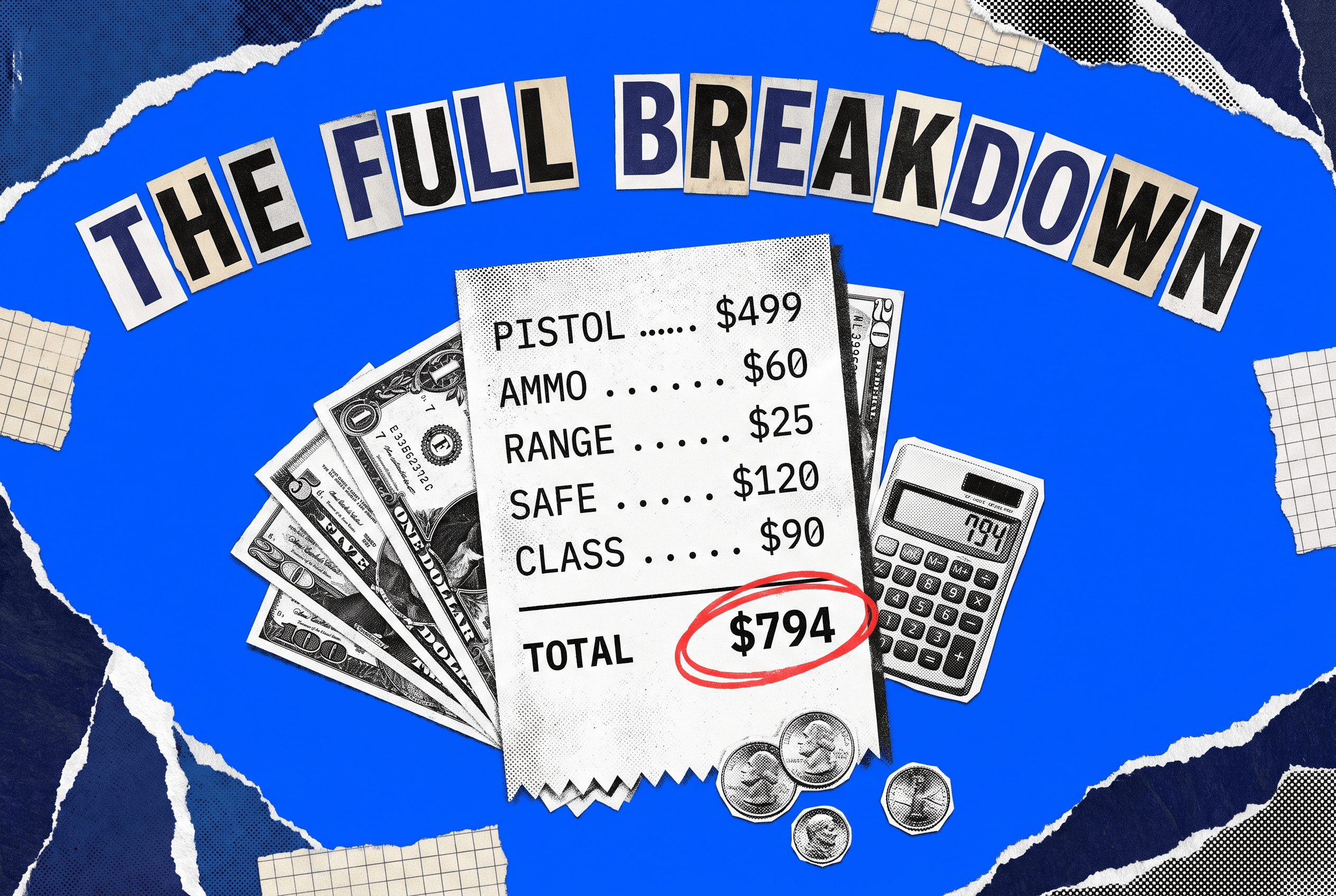
A first gun costs more than the price tag on the firearm, because the real total also includes secure storage, ammo, protection, and usually some training. What you spend depends on your choices, and most of it becomes predictable once you can see the full list in one place.
If every guide you have found either throws one scary number at you or lists prices that are already out of date, here is the full picture so you can plan with confidence.
The good news is that first-gun costs break into a short, knowable checklist of one-time and ongoing items, and you get to decide which of the optional ones matter. Our plain-English checklist of what you actually need to buy your first gun pairs closely with this breakdown.
Key takeaways
A first gun's true cost is the firearm plus a short list of essentials: secure storage, eye and ear protection, a holster, initial ammo, and usually a training class.
Costs split into one-time setup and ongoing expenses, and practice ammo is the single largest ongoing variable for most new owners.
An online purchase adds a one-time FFL transfer fee, since handguns ship to a licensed dealer for pickup rather than to your door.
Many costs are optional. A range membership, extra optics, and insurance are choices, not requirements to own with confidence.
New to all of this? American Gun Owners bundles the essentials into one matched kit, so the categories are handled in a single, predictable step.
What does a first gun actually cost?
A first gun costs the price of the firearm plus a handful of essentials, and the total lands in a budget, mid, or premium range depending on your choices. The firearm is only the anchor. Secure storage, eye and ear protection, a holster, some ammo, and often a training class round out what most new owners actually spend to get started with confidence.
Thinking in tiers helps more than chasing one number. A budget setup covers the essentials and nothing extra, a mid setup adds comfort and a little quality, and a premium setup layers on optics, a nicer safe, and more training. Because prices shift and vary by state, the useful skill is knowing which categories are essential and which are optional, so you can build the setup that fits your life.
The real cost checklist: one-time versus ongoing
The real cost of a first gun is easiest to see as a checklist split into one-time setup and ongoing expenses, with each item marked essential or optional. The table below is the whole picture on one screen. Most new owners are relieved to find that the truly essential list is short, and that the biggest long-term cost is simply how often they choose to practice.
| Cost | Timing | Essential or optional |
|---|---|---|
| The firearm | One-time | Essential |
| Secure storage (lockbox or safe) | One-time | Essential |
| Eye and ear protection | One-time | Essential |
| Holster | One-time | Essential for carry or home staging |
| Cleaning kit | One-time | Essential |
| FFL transfer fee | One-time | Essential for online or out-of-state buys |
| Initial function and sight-in ammo | One-time | Essential |
| Training class | One-time | Strongly recommended |
| Concealed carry permit fee | One-time (renews) | Optional |
| Practice ammo | Ongoing | Essential |
| Range fees or membership | Ongoing | Essential to practice |
| Maintenance supplies | Ongoing | Essential |
| Optics, light, or laser | One-time | Optional |
| Firearms liability insurance | Ongoing | Optional |
Notice how few items are truly required to start. The essentials cluster around confident ownership, and everything else is a choice you can add later as your interest grows.
What are the one-time costs?
The one-time costs of a first gun are the firearm, secure storage, eye and ear protection, a holster, a cleaning kit, and a small amount of ammo to confirm the gun works. These are the setup expenses you pay once to own with confidence. Storage matters more than new owners expect, and it pays off in peace of mind: only 8.2% of first-time buyers store a firearm unsecured and loaded, down sharply from 2020, per NSSF's First-Time Gun Buyers research.
If you buy online, add one more one-time item: the FFL transfer fee. A gun bought online ships to a local licensed dealer, who handles your background check and paperwork before you take it home. You can see how an FFL transfer works if that step is new to you. It is a normal part of buying a firearm, and it is the same whether you buy locally or online.
Ongoing costs to plan for
The main ongoing cost of gun ownership is practice ammo, followed by range fees and a little maintenance. Practice ammo is the single largest variable in the whole budget, because it scales directly with how often you train. A new owner who shoots monthly spends far less over a year than one who trains every week, and both are making a reasonable choice.
Range access is the next recurring item, and you can pay per visit or buy a membership if you go often. Maintenance is minor, mostly solvent and oil to keep the gun running. Optional ongoing costs like firearms insurance or a continuing training plan are worth considering, though none of them are required to own a gun with confidence. Building steady habits at the range is where confidence comes from, so finding training near you is money well spent.
How to budget as a first-time owner
The simplest way to budget for a first gun is to fund the essentials first, then add optional items over time as your interest and skills grow. Start with the firearm, secure storage, protection, a holster, and enough ammo to train, plus a class. That core setup gets you shooting with confidence without overspending on gear you cannot use yet.
From there, upgrades are a matter of preference, not necessity. A nicer safe, an optic, a range membership, or carry insurance can all wait until you know how you will actually use the gun. You are in large company on this path: more than 26.2 million Americans became first-time gun owners since 2020, and nearly three-quarters of first-time buyers sampled from 2021 to 2024 were women, per NSSF. Our first-time gun owner statistics breakdown covers who is buying, so the first-time budget question is one plenty of people are asking right now.
Does buying a kit cost less than buying everything separately?
A matched kit saves money, and it also saves you from buying the wrong thing twice, which is the trap most first-time owners fall into. When you piece a setup together one item at a time, it is easy to buy a holster that does not fit, a safe that is too small, or ammo the gun does not like. A kit built around a specific firearm removes that guesswork.
That is the thinking behind American Gun Owners. Instead of leaving you to assemble the categories above on your own, we match the firearm, the accessories, and the training-related pieces into one state-legal package, with the FFL transfer coordinated for you. You can see what comes in an all-in-one kit or let our Find My Gun Kit quiz size one to you. You should not have to guess your way through the setup.
Simple ways to keep your first-gun costs down
You can keep first-gun costs down by buying only the essentials at first, considering a quality used firearm, and practicing with cheaper ammo. A lightly used pistol from a reputable dealer can be a smart buy, since quality handguns are durable. Practicing part of the time with a .22 or with inexpensive range ammo stretches your budget while you build fundamentals.
The other saver is patience. You do not need every accessory in month one, and spreading optional purchases over time keeps the entry cost manageable. Focus your early spending on secure storage and training, the two things that build real confidence fastest, and let the extras come later. Take it at your own pace.
Frequently Asked Questions
How much does a handgun cost for a first-time owner?
A first handgun falls into budget, mid, or premium tiers, and most new owners land in the budget-to-mid range for a reliable compact. Rather than a fixed number, think in tiers, since prices vary by model, state, and whether you buy new or used. A dependable, moderately priced pistol is a better first purchase than the cheapest option on the shelf.
Can you buy a gun on a tight budget?
Yes. A budget-tier setup covers a reliable firearm and the must-have basics without extras. The key is to prioritize a dependable gun, secure storage, and training over accessories. You can always add optics, a nicer safe, or a range membership later as your interest grows.
How much does ammo cost to practice?
Practice ammo is the largest ongoing cost of gun ownership, and it scales with how often you shoot. Costs vary by caliber, with 9mm and .22 among the more affordable common options. Many new owners keep the budget in check by practicing part of the time with an inexpensive .22.
Do you have to pay an FFL transfer fee?
You pay an FFL transfer fee when a gun ships to a licensed dealer, which happens with online or out-of-state purchases. A straight in-store purchase from a local dealer does not add a separate transfer fee. The transfer covers the dealer handling your background check and paperwork at pickup.
Is it cheaper to buy a gun online or in a store?
Online prices can be lower, but the FFL transfer fee narrows the gap, so compare the full total. The right choice depends on selection and convenience as much as price. Buying as a matched kit can be more predictable, since it prevents the common cost of buying accessories that do not fit.
The full cost, no surprises
The full cost of a first gun is really a short checklist, not a single number, and most of it is in your control. Fund the essentials first, add the optional items as you go, and lean on training and secure storage as your best early investments. Do that, and the whole thing feels a lot more manageable than the headlines suggest. When you want the categories handled in one step, the Find My Gun Kit quiz is here for you.
Sources
National Shooting Sports Foundation, First-Time Gun Buyers Industry Research Report
National Shooting Sports Foundation, 26 Million New First-Time Gun Owners Since 2020 (Jan 2025)
Pew Research Center, Key Facts About Americans and Guns (2024)
Related
What You Actually Need to Buy Your First Gun: A Checklist
Is There an All-in-One Gun Kit for First-Time Buyers?
What Is an FFL Dealer? Your First Transfer, Explained
First-Time Gun Owner Statistics: Who Is Buying in 2026
Requirements for buying, owning, and storing a firearm vary by state and can change, so confirm what applies where you live.