How to Tell If a Handgun Fits Your Hand
By AGO
October 12, 2026
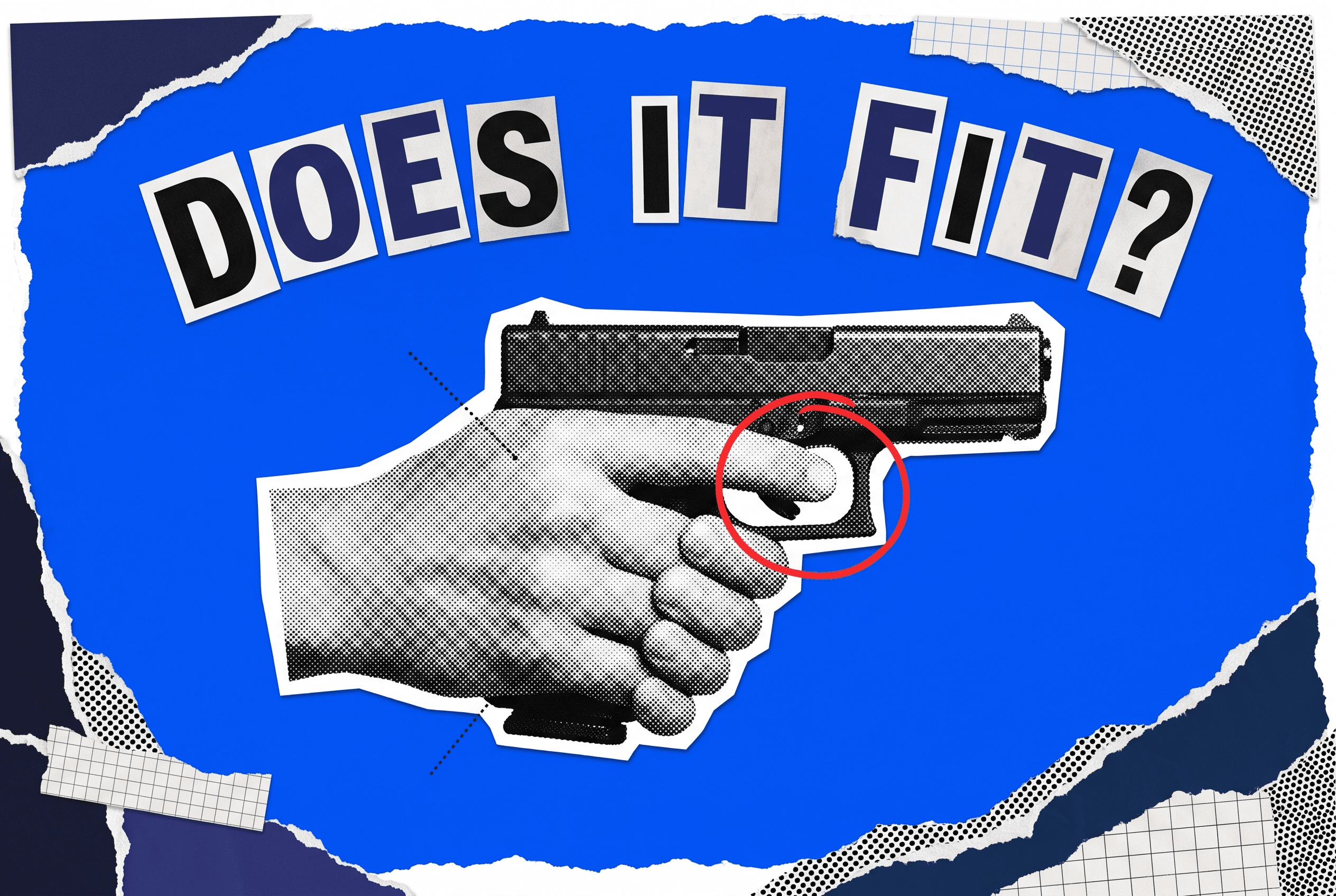
A handgun fits you if your trigger finger reaches the trigger without dragging the gun sideways and your hand closes around the grip without straining. Everything else about fit follows from those two, and both are things you can check in about ten seconds each.
You're standing at the case with something in your hand and no clear idea what you're supposed to be feeling for. The person behind the counter is waiting, and every article you read beforehand told you to measure your hand, which is not a thing you can do now.
American Gun Owners uses a five-part check for this, and our guide to picking a first handgun names it in passing. This is the page that explains it. This is a decision most new owners make early and then live with.
Key takeaways
-
Fit is five checks you run with the firearm in your hands, not a measurement you take beforehand.
-
Reach and Wrap are the two that disqualify a handgun outright, and the other three are usually adjustable.
-
A grip that's too small pushes your support hand into contact and sends shots off target, which is why smaller isn't automatically better.
-
One manufacturer offers three grip module widths for a single pistol, so the same model can fit three different hands.
-
The whole check takes under a minute at a counter.
The short version
| Run Reach and Wrap first, because a handgun that fails either one is the wrong handgun for you whatever else is true about it. The remaining three tell you whether it's a good fit or merely a possible one. |
|---|
What does it mean for a handgun to fit?
Fit means your hand can work the gun without changing its position, which makes it a function question rather than a size question. Two handguns with identical published dimensions can fit you completely differently depending on grip shape and where the controls sit.
Almost everything written about this converts fit into a number. One grips manufacturer publishes hand length in millimetres against grip sizes. A forum thread teaches a palm-to-fingertip measurement. A retailer blog lists grip thickness, width, length, angle and trigger reach as dimensions to compare. That's our reading of the results page as it stood in September 2026. The approach works fine for shopping, and it is simply answering a different question from the one you have at the counter.
A measurement is a shopping tool. It narrows what to look at before you've held anything, and it can't tell you which of several different problems you're feeling once you have. The check below is the other half: five things you do with the gun, each with a recognizable failure.
The Five R Fit Check
Reach, Wrap, Rack, Releases and Return are five things to do with a handgun before you decide anything about it. Run them in that order, because the first two settle the question and the last three refine the answer.
| The R | What it tests | What failing it looks like | Can it be fixed? |
|---|---|---|---|
| Reach | Whether your trigger finger meets the trigger without pulling the gun sideways. | The muzzle swings as you press, or your finger reaches past its first joint. | No, unless the trigger reach itself is adjustable. Otherwise it disqualifies the gun. |
| Wrap | Whether your hand closes around the grip with a firm, complete hold. | Your fingertips don't meet your palm, or they overlap onto themselves. | Sometimes, with a narrower or wider backstrap or grip module. |
| Rack | Whether you can work the slide without a fight. | You need a second attempt, or you end up bracing the gun against your body. | Often. Technique changes this considerably more than strength does. |
| Releases | Whether you can reach the magazine release and slide stop without shifting your grip. | You have to roll the gun in your hand to reach a control. | Sometimes, with extended or reversible controls offered by the manufacturer. |
| Return | Whether the sights come back to where they started after a shot. | The sights land low, high or off to one side each time. | Usually, with practice and a grip correction. |
Reach and Wrap are the disqualifiers because neither one is about skill. A trigger you can't reach cleanly will move the muzzle every time you press it, no matter how much you practice, and a grip your hand can't close around gives you nothing to hold the gun still with.
Worth saying once: none of the five is a judgment about you. A handgun that fails Wrap is a handgun built around a different hand, and there are thousands of them. The check exists so you can find that out in a shop rather than discovering it a hundred rounds into an afternoon.
How do you run the check at a gun counter?
Ask to handle it, let the person behind the counter confirm it's empty and hand it to you, then work through the five in order. Nobody will think anything of it, and a shop that minds is telling you something useful. That is also where most of this happens. NSSF's handgun consumer research reports that the majority of handgun buyers usually purchase handguns at local gun stores, so handling several at a counter is the ordinary way to buy rather than an unusual request. If this is your first firearm you are in the common case too, because NSSF's research on first-time gun buyers reports that handguns are by far the most popular first purchase.
Reach and Wrap take ten seconds each, and if a handgun fails either one, nothing else about it matters. That's the sentence worth carrying in with you. Rack, Releases and Return take another thirty seconds between them, and Return you'll only fully answer at a range, so treat it as the one to check later rather than the one to skip.
Handle three or four in a session rather than one. Fit is comparative, and the difference between a gun that works for your hand and one that nearly does is much easier to feel back to back than it is in isolation.
Why a smaller grip is not automatically a better fit
Too little grip is its own failure, and it shows up as shots pushed off target rather than as anything that feels uncomfortable. This is the part that surprises people with smaller hands, who arrive assuming the smallest gun in the case is the one for them.
SIG SAUER's discussion of proper pistol fit sets out the mechanism. If your trigger finger has too little to reach across, your support hand can come into contact with it, and that contact pushes shots off target. SIG names a grip that's too small as the most common cause. The same discussion distinguishes pressing the trigger with the pad of the finger from pressing at the first joint, and notes that going past that joint pulls shots to one side.
So the failure runs in both directions, and the check catches both. Wrap tells you the grip is too large for your hand. Reach, run carefully, tells you when it's too small, because your finger arrives at the trigger with too much of itself already through the guard.
What if no handgun in the case feels right?
Nothing fitting usually means the shop's selection is narrow rather than that your hand is unusual. A counter with a dozen pistols in it is showing you a fraction of what exists, and most of that dozen will be built around the same grip assumptions.
Two things are worth doing before you conclude anything. Try a range that rents, because you'll get your hands on more variety in an hour than a shop can show you in a week. And if your hands are on the smaller side specifically, our guide to measuring your grip covers the measurement side properly, which is genuinely useful for narrowing a search before you travel to handle anything.
The Find My Gun Kit quiz approaches it from the other end, matching you to a complete setup that's legal where you live. Our guide to handguns that fit smaller hands well is also worth a look if the case keeps producing the same answer.
If you can, bring someone who shoots and ask them to run Return with you at a range rather than in the shop. Return is the only one of the five that needs live fire, and it is also the one most likely to be a grip problem rather than a gun problem, which a second pair of eyes will spot in a couple of magazines.
Fit you can change, and fit you cannot
Grip circumference and trigger reach are adjustable on a lot of modern pistols, and grip length is not. Knowing which side of that line a problem sits on saves you from writing off a gun that would fit you with a part swap at the shop.
Interchangeable backstraps have been common for years, and some designs go further. SIG offers three grip module widths for one of its pistols, small, medium and large, which means the same model can be three different guns as far as your hand is concerned. Any of this is a manufacturer option fitted by the shop or the maker, not something to attempt yourself.
Grip length, meaning how much of the front strap your fingers have to sit on, is fixed by the frame. If your little finger has nowhere to go, that's a different gun rather than a different part, which is where frame size comes into the conversation.
Finding the one that disappears in your hand
The right handgun is the one you stop noticing, and you'll know inside five checks. That's the whole test: a gun that fits stops being something you're managing and becomes something you're using.
Run the five on whatever you can get your hands on, ideally several in a row. Then book an hour with an instructor and run Return properly, because that one needs live fire and a second pair of eyes. AGO's training access connects you with instructors near you, and fit is something they assess in the opening minutes as a matter of course.
Frequently Asked Questions
How do you measure your hand for a handgun?
The usual method is the distance from the base of your palm to the tip of your middle finger, compared against a manufacturer's grip size chart. It's a reasonable way to narrow a search before you travel to handle anything. Our guide to measuring your grip covers it properly, and it's a different job from the check on this page, which you run with the gun already in your hand.
Does grip size affect accuracy?
Yes, and in both directions. A grip too large for your hand stops you getting a firm, complete hold, and a grip too small lets your support hand interfere with your trigger finger. SIG SAUER names the second of those as the most common cause of shots being pushed off target, which is the one most people do not expect.
Can you change the grip on a handgun to fit your hand better?
On many modern pistols, yes. Interchangeable backstraps are common, and some designs use a removable grip module offered in several widths. What you cannot change is grip length, meaning how much room your fingers have on the front of the grip. Any part change is a manufacturer option fitted by the shop or the maker.
Where should your trigger finger sit on the trigger?
Somewhere between the pad of the fingertip and the first joint, and which of those suits you is partly personal. SIG SAUER notes that some shooters press with the pad and some at the joint, and that going past the joint tends to pull shots to one side. If you cannot reach the trigger without going past it, the gun is too large for your hand.
Is a smaller handgun easier for someone with smaller hands?
Not automatically, and assuming so is a common and expensive mistake. A shorter grip gives your hand less to hold, which usually makes recoil harder to manage, and too little trigger reach creates its own accuracy problem. Run Wrap and Reach on both sizes before deciding, because the answer is frequently the middle option.
Sources
-
SIG SAUER, Discussion: Proper Pistol Fit, sigsauer.com
-
National Shooting Sports Foundation, Industry Research Report: Handgun Consumer Study 2025 Edition, nssf.org
-
National Shooting Sports Foundation, Industry Research Report: First Time Gun Buyers, nssf.org
Related
We strive to provide accurate, up-to-date information to help first-time firearm owners make informed decisions. Because laws and regulations vary and may change, always verify the requirements that apply to your location and and handle every firearm with care.