Women's Gun Classes: What They Cover and How to Find One
By AGO
September 8, 2026
Last updated: September 14, 2026
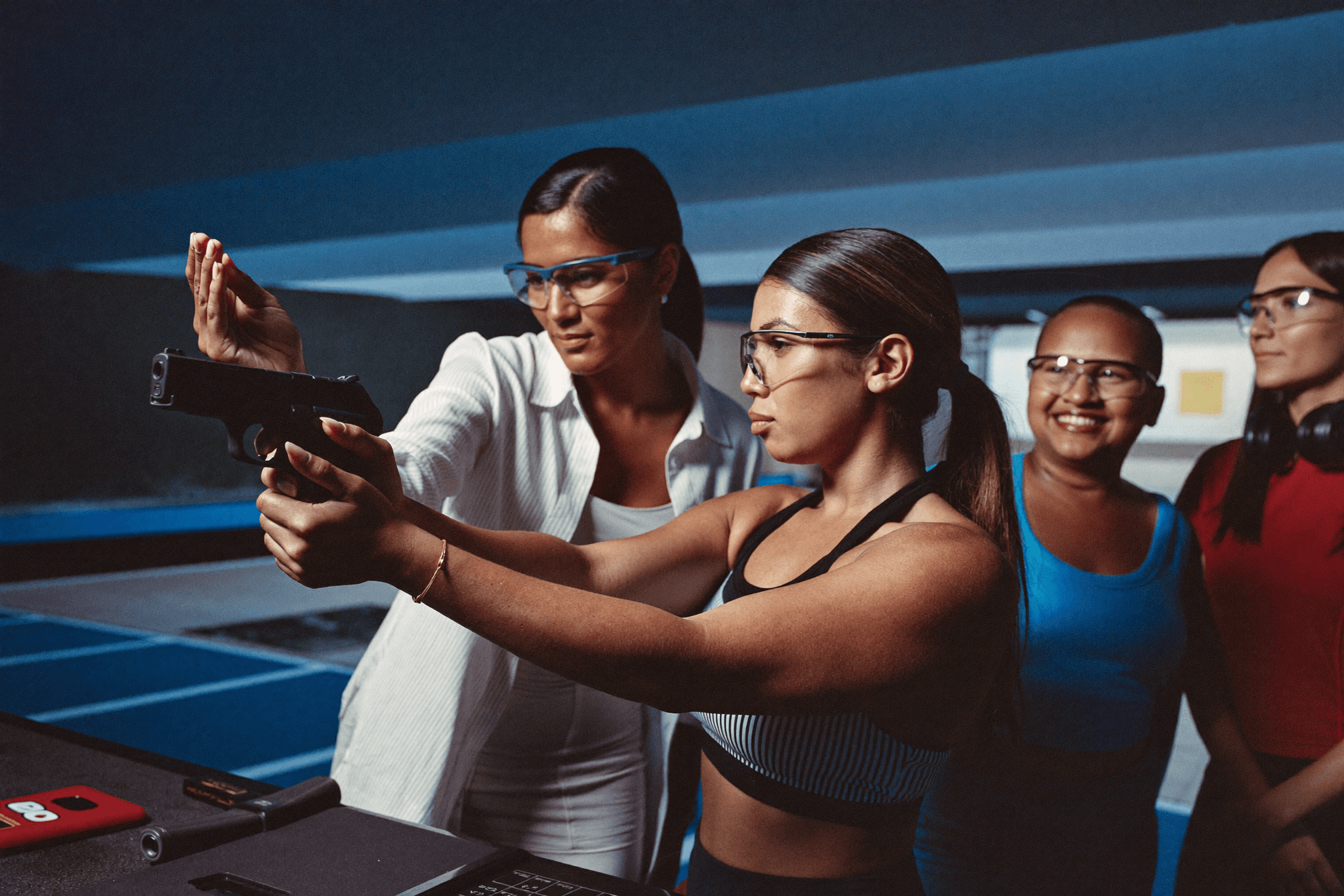
Women's gun classes cover handling, marksmanship, and defensive fundamentals, and they run in three tiers from first-touch introductions through defensive carry courses.
Search for one and you'll get a dozen range websites, each describing its own course in its own vocabulary. One calls it a Ladies Only Pistol Class, another calls it Women's Basic Protection, a third lists three levels with no explanation of what separates them. Most range websites describe their own class and assume you already know which one you need.
You don't have to. The category has a structure, and once you can see it, picking the right class takes about two minutes. If you're earlier in the process than this, our woman's guide to buying her first firearm covers the ground before training.
Key takeaways
-
Women's classes fall into three tiers, and most first-timers want the first one.
-
A first-tier class covers the handling rules, how a pistol works, loading and unloading, stance, grip, and trigger press.
-
Four routes will find you a class: two national instructor directories, a nationwide clinic program, and your local range.
-
Most classes provide the firearm and the ammunition, so you don't need to own a gun before your first one.
-
Women made up nearly three quarters of first-time gun buyers sampled between 2021 and 2024, which is why these classes now run as their own category.
The short version
-
Tier 1, first touch: you've never fired a gun, or fired one once. Handling rules, how a pistol works, your first live rounds.
-
Tier 2, fundamentals: you own a firearm and want to shoot it well. Stance, grip, sight alignment, trigger control.
-
Tier 3, defensive and carry: you're carrying or planning to. Holsters, concealed carry, defensive fundamentals.
What do women's gun classes cover?
A women's gun class covers the handling rules, how a pistol works, loading and unloading, and the fundamentals of stance, grip, and trigger press. The ladies-only pistol class syllabus published by Defensive Strategies is representative: rules for handling, pistol parts and operation, ammunition, shooting fundamentals, the two-handed standing position, and cleaning the pistol afterward.
Higher levels add range. Intermediate and advanced listings on ShootingClasses.com cover concealed carry and permit training, defensive handgun applications, and an introduction to holster skills, which is the step up from a first-touch class. Advanced course pages also list use-of-force material, which is a topic those instructors cover in person and not something to learn from an article.
What almost every syllabus has in common is that live fire comes at the end, after the handling and the fundamentals. If you're weighing whether to train before you buy at all, our guide on taking a gun safety class before you buy works through that decision.
The three tiers of women's classes
Women's classes sort into three tiers: a first-touch introduction, a fundamentals and marksmanship course, and a defensive or carry course. Ranges name them differently, which is most of why the search results look chaotic, but the underlying structure is consistent. Find your tier and the naming stops mattering.
| Tier | What it covers | Who it's for |
|---|---|---|
| Tier 1, first touch | The handling rules, parts of a pistol and how it works, ammunition, loading and unloading, the two-handed standing position, first live rounds. | You've never fired a gun, or fired one once and want to start properly |
| Tier 2, fundamentals and marksmanship | Stance, grip, sight alignment, sight picture, breathing, and trigger control, worked until your groups are consistent. | You own a firearm and want to shoot it well |
| Tier 3, defensive and carry | Concealed carry and permit training, defensive handgun applications, an introduction to holster skills. | You're carrying or planning to, after tiers 1 and 2 |
Aggregator listings label these basic, intermediate, and advanced. If a course page doesn't say which level it is, the giveaway is whether it assumes you own a gun.
Why women-only classes exist at all
Women-only classes exist because the mixed-class dynamic stops a lot of first-timers from asking questions, and the format removes that friction. That's the whole mechanism. It isn't that the curriculum differs; a trigger press works the same regardless. It's that people ask more questions when nobody in the room is performing expertise at them.
The demand is not niche. NSSF's first-time gun buyer research found women made up nearly three quarters of first-time buyers sampled between 2021 and 2024, up from slightly under half in 2020, and handguns are by far the most common first purchase. The class you're looking for is now being built for the largest group of new owners, not a side segment.
Plenty of readers aren't nervous at all and just want good instruction, which these classes also deliver. Our guide on whether a gun is the right choice for you covers the question that sits underneath, if you're still on it.
How do you find a women's gun class near you?
Four routes will find you a class: two national instructor directories, a nationwide clinic program, and the range closest to you. Each covers different ground, and the local range is the one most people skip even though it's often the shortest drive.
| Route | What it is | How you search it |
|---|---|---|
| ShootingClasses.com | A national course aggregator listing instructors and ranges | Search by ZIP code or state, then filter by course type, firearm type, women's-only, private instruction, and language, including Spanish-language classes. The women's-only filter returned 39 courses when we checked in September 2026. |
| A Girl & A Gun instructor directory | A sortable roster of affiliated female firearms instructors | Sort by name or state. Each row lists the instructor, her training company, location, contact details, and certification level: Certified Instructor, Certified Trainer, or Certified Facilitator. Coverage spans Texas, Pennsylvania, Ohio, Florida, California, Washington, Michigan and more, plus Guam. |
| Women On Target clinics | A nationwide instructional shooting clinic program for women | An online map and search form, browsable by state. Clinics run periodically rather than continuously, so availability depends on timing in your area. |
| Your local range | Ranges often run their own women's course | Call and ask what women's classes they run and how often. Many never appear on an aggregator, so this route finds classes the other three miss. |
Use two routes rather than one. Aggregator coverage is uneven by region, and a range twenty minutes away can be invisible on both directories. AGO's training access works the same problem from the other end by connecting you with instructors by zip code.
What should you ask before you book?
Ask whether the class provides a firearm, what the student-to-instructor ratio is, and whether live fire is included. Course pages are written to sell the class, so the details that decide whether it suits you are usually the ones left off. Three emails will tell you more than an hour of reading listings.
The full list worth asking: Does the class provide a firearm and ammunition, or do you bring your own? Is live fire included, or is the session classroom-only? How many students per instructor? What certification does the instructor hold? Is it genuinely women-only, including the instructor? How long is the session? And is there a follow-on class, so you're not starting over somewhere else at tier 2?
That last one matters more than it sounds. Training compounds when it's sequential, and a range that runs all three tiers gives you somewhere to go next. If you're choosing the firearm alongside the training, the Find My Gun Kit quiz takes a couple of minutes.
What to bring to your first class
Most classes supply the firearm, ammunition, and eye and ear protection, so you mainly need closed-toe shoes and a high-necked top. That's the practical answer to the question people are most self-conscious about asking. You are not expected to arrive equipped.
The clothing detail has a reason behind it: spent brass ejects hot and a scoop neckline catches it, which is uncomfortable and distracting on your first day. Closed-toe shoes serve the same purpose. Tie long hair back, and skip anything you'd mind getting solvent on.
Sessions run from a couple of hours to multi-day programs depending on the tier, and aggregator listings show single-session workshops alongside one-day and two-day options. Confirm the length when you book so you can plan around it. If you're bringing your own firearm and aren't sure it fits you well, our guide to finding a handgun that fits is worth reading first.
Finding the class that fits where you are
Start with the tier that matches what you've already done, then use whichever route covers your area best. If you've never fired a gun, that's tier 1 and almost any provider has one. If you already own a handgun, skip to tier 2 and you'll spend the day on the fundamentals that actually change your groups.
You're joining the largest group of new gun owners in the country, and the training market has reorganized itself around that fact over the last few years. The class you find will be better than the one that existed five years ago, largely because so many people asked for it.
American Gun Owners is built so the training piece isn't something you have to go find on your own. Every kit includes access to instructors nationwide, matched by zip code, with structured paths for home defense and concealed carry rather than a single disconnected class. If you're still choosing the firearm this all starts with, the Find My Gun Kit quiz is the fastest way to see what fits you.
Frequently Asked Questions
Do I need to own a gun to take a women's gun class?
No. Most first-tier classes provide the firearm and ammunition, which is part of why they're a sensible step before buying. Trying several pistols under instruction tells you more about what fits your hand than any amount of reading. Confirm when you book, since a few classes expect you to bring your own.
How long does a women's gun class take?
It depends on the tier. Introductory sessions commonly run a few hours, and aggregator listings show single-session workshops alongside one-day and two-day programs for higher tiers. A first class is usually an afternoon. Ask for the schedule when you book, since range time and classroom time are often split across the session.
Are women-only classes better than mixed classes?
Neither is better in curriculum terms; the material is the same. Women-only classes remove a social dynamic that stops some people asking questions, and asking questions is most of what makes a first class worth taking. If that dynamic doesn't affect you, a mixed class with a good instructor works just as well.
Do I need a class before I can buy a gun?
Federally, no. Some states require a permit or a course before purchase or before carrying, so requirements vary by where you live. Plenty of people take a class first anyway, because handling several firearms under instruction makes the buying decision much easier. Confirm what your state requires.
What if I have never touched a firearm before?
That's exactly who tier 1 is built for, and instructors running these classes see it constantly. The session starts with the firearm unloaded and on a table, covers how it works before anything else happens, and reaches live fire only once the handling is comfortable. Being new is the expected starting point, not an exception.
Sources
-
National Shooting Sports Foundation, First-Time Gun Buyers research: nssf.org
-
ShootingClasses.com, Women's-Only Courses: shootingclasses.com
-
A Girl & A Gun, Women's Firearms Instructors directory: agirlandagun.org
-
Defensive Strategies, Ladies Only Pistol Class: defensivestrategies.org
Related
We strive to provide accurate, up-to-date information to help first-time firearm owners make informed decisions. Because laws and regulations vary and may change, always verify the requirements that apply to your location and follow safe firearm handling practices.