Best Handgun Cleaning Kits for First-Time Owners
By AGO
September 3, 2026
Last updated: September 14, 2026
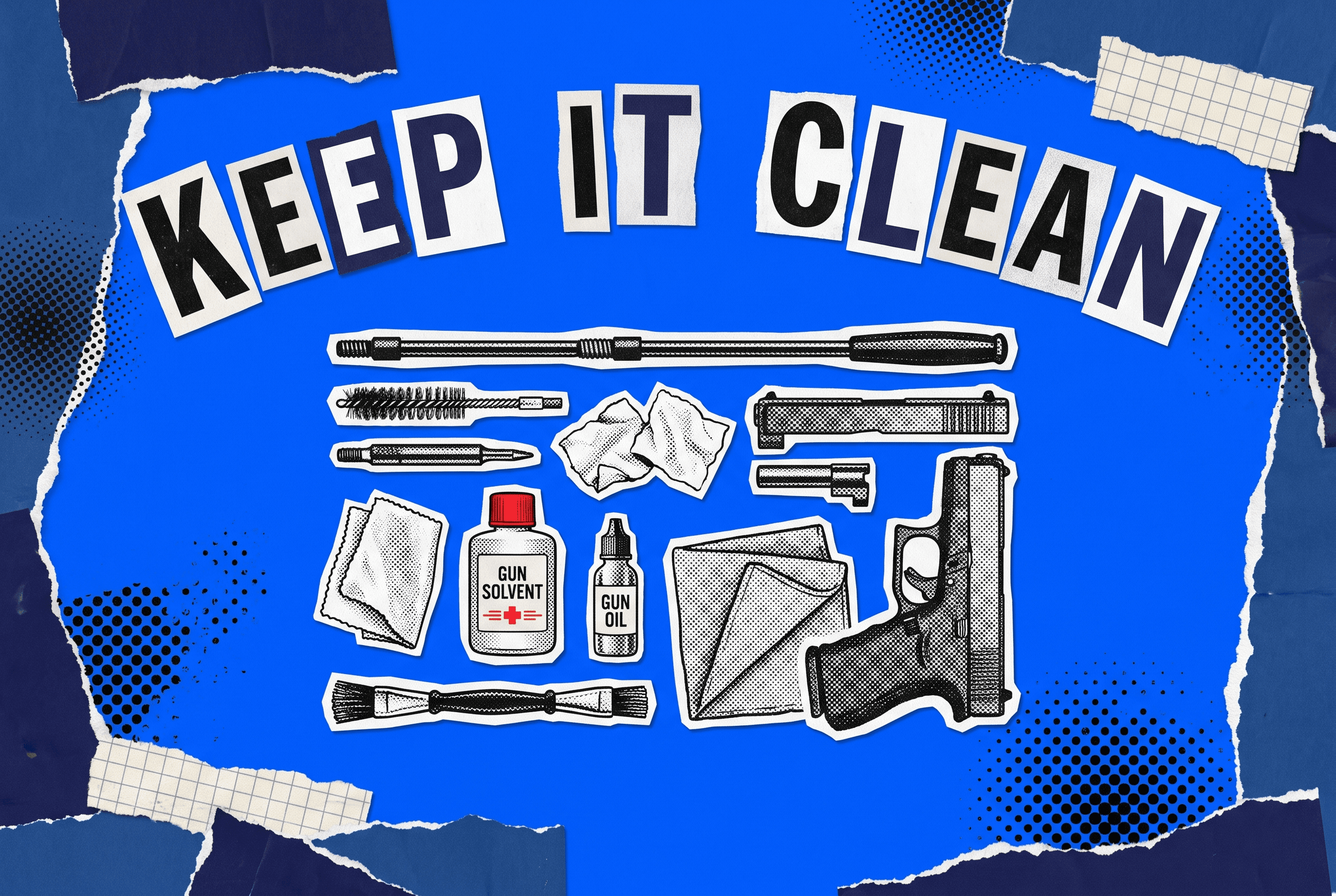
A handgun cleaning kit needs a rod or pull-through cable, a caliber-matched bore brush, patches, a jag, solvent, and lubricant. Everything past that is convenience.
Here's the problem with shopping for one. You're looking at two kits, and one has 13 pieces while the other has 38. Nothing on either listing tells you what the extra 25 pieces do, or whether your pistol needs any of them. The piece count is doing all the talking, and it's the least useful number on the page.
So let's start somewhere more useful: what the kit is actually for. Once you know which parts of a handgun get dirty, the shopping decision takes about a minute. If you're still assembling the rest of your setup, our guide to what comes in an all-in-one gun kit covers the pieces that show up before this one.
Key takeaways
-
Four published kit guides agree on eleven components, but only eight of them are what it takes to reach every surface of a handgun.
-
Piece count is not quality. A 13-piece handgun kit and a 38-piece universal kit can clean the same pistol equally well.
-
A handgun gets dirty in four places: the bore, the chamber and breech face, the feed ramp and rails, and the exterior.
-
Cadence tracks use, not the calendar. Clean after a range session, wipe a carry gun down every week or two, and check a stored firearm twice a year.
-
A brand new handgun arrives coated in packing grease, which is a preservative and not a lubricant, so it wants a wipe-down before its first trip to the range.
The short version
-
Best all-around for one handgun: a caliber-specific pistol kit with a coated rod, a bore brush, a jag, patches, solvent, and oil.
-
Best for two or more calibers: a universal kit with a full brush and jag set, which stops you rebuying a kit per gun.
-
Best for carry-gun upkeep between range trips: a bore snake and a CLP wipe, which handle a quick pass in about a minute.
-
Best minimum viable setup: rod, brush, jag, patches, solvent, oil, a nylon brush, and a rag. That's the whole job.
What should a handgun cleaning kit include?
A handgun cleaning kit should include a cleaning rod or pull-through cable, a caliber-matched bore brush, patches, a jag, solvent, and lubricant. Those six get fouling out of the barrel and put a protective film back on the metal, which is the core of the job. A nylon utility brush and a rag round it out by reaching the parts of the gun a rod never touches.
The thing worth knowing is that the components are standardized across the category. A jag from one kit fits a rod from another, because the threading is largely common. That means you're buying a bundle of commodity parts, and the real question is whether the bundle matches your gun rather than whether one brand's patches are special. If you're still working through the wider first-purchase list, our plain-English checklist for buying your first gun sets out what comes before accessories.
What is actually in a cleaning kit, counted across four guides
We counted the component lists across four published cleaning-kit guides to separate the pieces every one of them names from the optional extras. All four agree on eleven components. Only eight of those eleven are what it takes to reach all four surfaces of a handgun, and the other three are convenience or storage.
The count covers Outdoor Life, Gun University, CAT Outdoors, and Survival Stoic, each checked in September 2026.
| Component | Guides listing it | What it reaches | Verdict for one handgun |
|---|---|---|---|
| Cleaning rod or pull-through cable | 4 of 4 | Bore | Required |
| Bore brush, caliber-matched | 4 of 4 | Bore | Required |
| Cleaning patches | 4 of 4 | Bore, chamber | Required |
| Jag | 4 of 4 | Bore | Required |
| Slotted tip | 4 of 4 | Bore, chamber | Required |
| Solvent | 4 of 4 | All four surfaces | Required |
| Lubricant or gun oil | 4 of 4 | Rails, exterior | Required |
| Nylon utility brush | 4 of 4 | Feed ramp, rails | Required |
| Cleaning picks | 4 of 4 | Feed ramp, locking lugs | Convenience |
| Bore snake or pull-through rope | 4 of 4 | Bore, quick pass | Convenience |
| Case or organizer | 4 of 4 | Your shelf, not the gun | Convenience |
| Chamber brush | 3 of 4 | Chamber | Convenience |
| Microfiber or silicone cloth | 3 of 4 | Exterior | Required, a rag works |
| Cleaning mat | 3 of 4 | Your table, not the gun | Optional |
| Bore guide | 2 of 4 | Rifle bores mainly | Skip for a handgun |
| Bore mop | 2 of 4 | Bore, oiling pass | Skip for a first kit |
Read the table as a coverage map rather than a shopping list. A kit that carries the eight required rows is complete for one pistol, whatever number the box advertises.
The Four-Surface Check
A handgun gets dirty in four places, and a kit is only complete if it reaches all four. We call it the Four-Surface Check, and it replaces piece count as the thing to judge a kit by. Run it against any listing and you'll know in seconds whether the kit covers your gun.
One, the bore. The inside of the barrel, reached by the rod or cable with a brush, then a jag pushing patches. Two, the chamber and breech face. Where the round sits and where the firing pin lives, reached by a patch on a slotted tip or a chamber brush. Three, the feed ramp and rails. The surfaces the round slides across, reached by a nylon brush and a pick. Four, the exterior. Everything you touch, reached by a cloth and a thin film of oil.
Revolvers change one step, since you're cleaning the chambers of a cylinder rather than a single chamber, and shotguns move to a bore of a different size. Our guide to pistols, revolvers, and shotguns covers how the three types differ. The four surfaces hold across all of them.
How often should you clean a handgun?
Clean a handgun after every range session, wipe a carry gun down every week or two, and check a stored firearm twice a year. Cadence tracks how the gun is used rather than a date on the calendar, which is why a single blanket interval never fits. The table below maps the four common situations to a rhythm and the reason behind it.
| How you use it | Cadence | Why |
|---|---|---|
| Range gun | After each session, per Outdoor Life; every 400 to 500 rounds by Gun University's own practice | Fouling builds with round count, so the interval follows rounds fired |
| Carry gun | A light wipe-down on a two-week interval, per Otis Technology | It collects sweat, body heat, and lint even in a week you never fire it |
| Stored home-defense gun | An inspection twice a year, per Otis Technology; once or twice a year per Gun University | Oil migrates and settles over months, so the check is about the film, not fouling |
| Brand new gun | Once, before the first range trip | Factory packing grease is a preservative for shipping and is not meant to work as a lubricant |
Heavier sessions shift the numbers. Otis Technology puts a quick clean at 250 to 300 rounds, while Survival Stoic describes a basic clean every few hundred rounds as enough for most range shooters. If your gun lives in a container between sessions, our guide to storing a gun at home covers the other half of that routine.
Universal kit or caliber-specific?
A caliber-specific kit is the simpler choice for one handgun, and a universal kit earns its place once you own two or more calibers. The difference is entirely in the brushes and jags, which are sized to the bore. Everything else in the box works the same either way.
A caliber-specific pistol kit gives you exactly the brush and jag your gun takes, and none of the pieces that would sit unused. A universal kit carries a spread instead. Gun Digest's hands-on look at one multi-caliber system describes coverage running from 9mm and .45 through .223 and 5.56, .308 and 7.62, and 12-gauge, which is the appeal once a second gun arrives. Sizes are printed on the brush, so match it to the caliber stamped on your slide or barrel. Our explainer on gun calibers untangles the numbering if that stamp doesn't mean much yet.
Our read: buy caliber-specific for a first handgun. Universal kits are priced for the range they cover, and paying for a 12-gauge brush you don't own is the most common way a first kit gets more expensive than it needed to be.
What you can skip in your first kit
The pieces the guides disagree on, and a few they all list, are genuinely optional for one handgun. Skipping them costs you nothing in how clean the gun ends up. A bore guide appears in only two of the four guides we counted and is aimed mainly at rifle bores, so it's not doing much for a pistol. A bore mop shows up in two of four and duplicates a job a patch already does.
A cleaning mat, at three of four, protects your table rather than the gun. A cased kit is convenience, and a solvent that doubles as lubricant and preservative, which Gun Digest describes as an all-in-one product, can collapse two bottles into one. None of these change the outcome. They change how tidy the bench looks, which is a real preference and a different question from whether the gun is clean.
The genuine time-saver in the optional column is the bore snake. It pulls through in one motion and turns a quick post-range pass into about a minute of work, which matters more for consistency than any deep-clean tool does. If you're still deciding which firearm you're building this routine around, the Find My Gun Kit quiz is the fastest way to see what fits you.
Setting up your bench without overthinking it
Buy the eight pieces that reach all four surfaces, match the brush to your caliber, and add extras only when a job actually calls for one. That's the entire decision, and it holds whether the kit on the shelf advertises 13 pieces or 38. You're buying coverage, and coverage is a short list.
Over a million people bought a first firearm in recent years, and most of them worked this out from a product listing that never explained it. American Gun Owners exists to take that step out of the guesswork, from the firearm itself through the dealer pickup and the training that follows. Every kit ships with a protective case so the gun has somewhere to live from day one, and your training access connects you with an instructor near you who'll walk you through a field-strip in person, which beats any written guide including this one. When you're ready to see what setup suits you, start with the Find My Gun Kit quiz.
Frequently Asked Questions
Do I need a cleaning kit if I only shoot a few times a year?
Yes, though a small one covers it. Even a firearm that rarely gets fired collects dust and loses its oil film over months, which is why Otis Technology suggests checking a stored gun about twice a year. A rod, patches, solvent, oil, and a rag handle that inspection. You don't need a multi-caliber system for a gun that sees a couple of sessions annually.
Can I use household oil like WD-40 instead of gun oil?
It's not built for the job. General-purpose penetrating sprays are formulated to displace water and free stuck parts, not to hold a lubricating film on rails under repeated cycling, and they can creep into places you'd rather keep dry. Purpose-made gun oil or an all-in-one CLP costs little and behaves predictably. Use the product designed for the surface.
What is the difference between a bore snake and a cleaning rod?
A rod pushes tools through the barrel in stages, so you can brush, then patch, then oil, with control at each pass. A bore snake is a weighted rope you pull through once, carrying an integrated brush and cloth together. The rod does a more thorough job, and the snake does a faster one. Many owners keep both and use the snake between range trips.
Does a brand new handgun need cleaning before its first range trip?
Generally yes. Firearms ship with a protective coating applied to prevent corrosion in storage and transit, and that coating is a preservative rather than a working lubricant. A wipe-down and a fresh application of gun oil before the first session puts the right film where it belongs. It also gets you familiar with taking the gun apart while nothing is urgent.
Will cleaning my handgun the wrong way damage it?
Ordinary cleaning is hard to get badly wrong, though a couple of habits are worth avoiding. Use a coated or brass rod rather than bare steel, since softer metals are gentler on the rifling, and don't leave solvent sitting on the finish for hours. Your owner's manual specifies the field-strip steps for your model, and an instructor can walk you through the first one.
Sources
-
Outdoor Life, Best Gun Cleaning Kits, Tested and Reviewed: outdoorlife.com
-
Gun University, Best Gun Cleaning Kits: gununiversity.com
-
CAT Outdoors, Best Gun Cleaning Kits: catoutdoors.com
-
Survival Stoic, Best Gun Cleaning Kits: survivalstoic.com
-
Otis Technology, How Often Should You Clean Your Gun: otistec.com
-
Gun Digest, Hands On, The Best Gun Cleaning Kit: gundigest.com
Related
-
What You Actually Need to Buy Your First Gun: A Plain-English Checklist
-
The Right Tool for the Job: Pistols, Revolvers, and Shotguns
We strive to provide accurate, up-to-date information to help first-time firearm owners make informed decisions. Because laws and regulations vary and may change, always verify the requirements that apply to your location and follow safe firearm handling practices.