Open, Concealed, and Constitutional Carry Explained
By AGO
October 28, 2025
Last updated: October 2, 2026
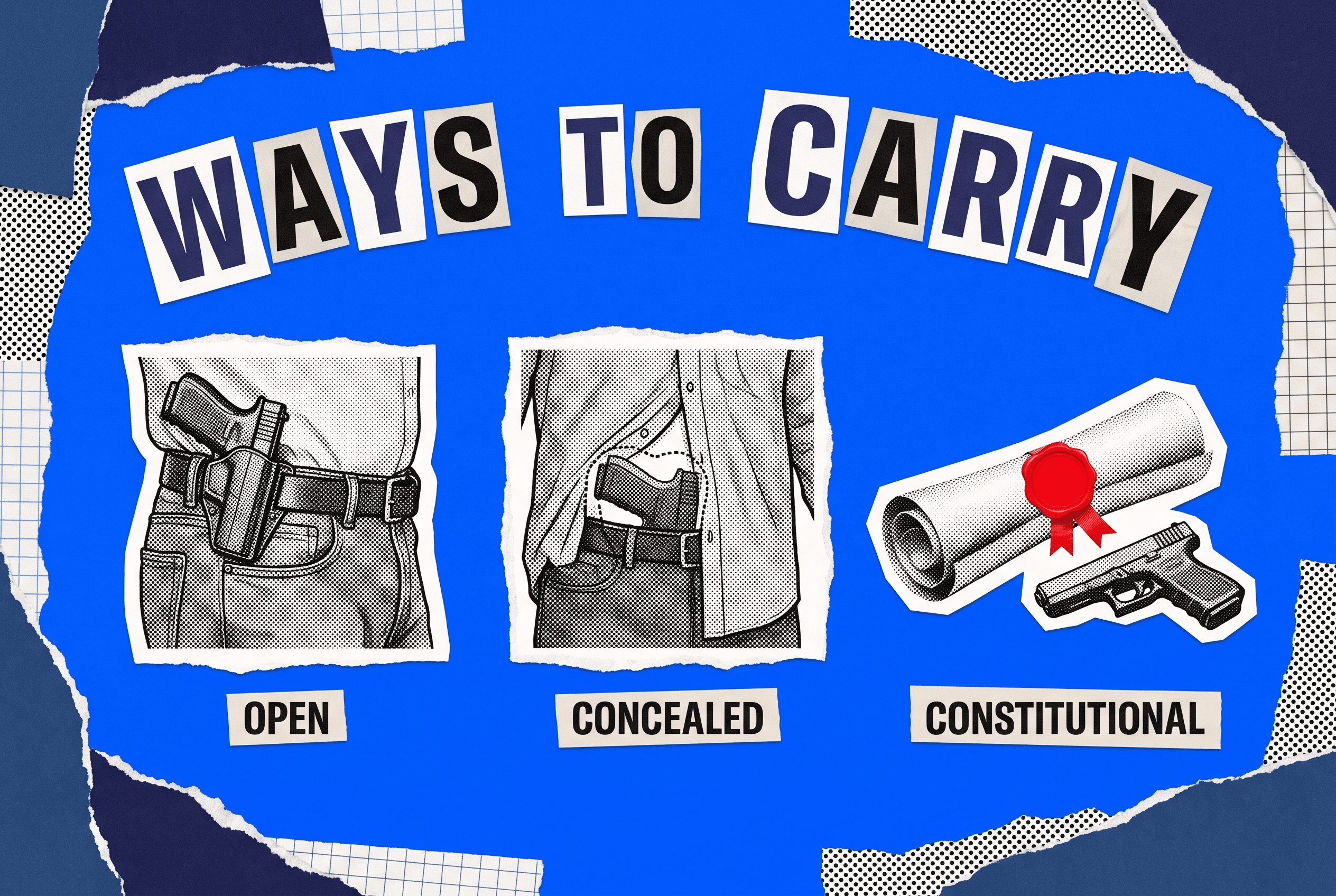
Open, concealed and constitutional carry describe what your own state permits, and reciprocity describes whether another state recognizes it. Three of those four words answer one question and the fourth answers a completely different one.
Three of these four words describe the same kind of thing and the fourth does not, which is why the list never quite makes sense the first time you read it. Almost every page covering this lines them up as though they were four options on a menu.
American Gun Owners wrote this as vocabulary rather than as an argument. If you want the wider compliance picture, our guide to which gun laws apply to you covers buying, storing and carrying together.
Key takeaways
-
Three of the four terms describe what you may do, and reciprocity describes what another state recognizes.
-
Open carry means the firearm is visible, and concealed means it is not.
-
Constitutional carry, also called permitless carry, means a state allows carry without a state-issued permit.
-
A permit issued by one state is recognized by another only where that state chooses to recognize it.
-
ATF publishes a compilation of state firearms laws, currently in its 36th edition, updated January 15, 2026.
The short version
| Open and concealed describe whether the firearm is visible. Constitutional carry describes whether your state requires a permit at all. Reciprocity is a separate question about what happens when you cross a state line. |
|---|
What are the different types of gun carry?
Three terms describe how you carry or whether you need a permit, and one describes recognition between states. Sorting them into those two groups is the thing that makes the vocabulary usable.
| Term | What it governs | What it means | Which question it answers |
|---|---|---|---|
| Open carry | Whether the firearm is visible | It is visible | What your state permits |
| Concealed carry | Whether the firearm is visible | It is not visible | What your state permits |
| Constitutional carry | Whether a state-issued permit is required at all | No permit required in that state | What your state permits |
| Reciprocity | Whether another state honors the permit you hold | Varies by the state you enter | What another state recognizes |
Read the last column and the shape of the subject becomes obvious. The first three are all answers to a question about where you live. The fourth is an answer to a question about somewhere you are going, and it depends on a decision made by a government you have no relationship with.
The Two Questions
Every carry question splits into what your own state permits and what another state recognizes. Work out which one you are asking before you go looking, and most of the confusion on this subject disappears.
Three of those words are about what you may do, and reciprocity is about what somebody else recognizes, which is why a permit is not a passport. Recognition also runs in one direction at a time, so two states can reach different conclusions about each other, and a pairing that works traveling one way does not automatically work coming back. That is the practical consequence and it is the error worth avoiding: people assume a permit is a thing they hold, like a driving license, rather than a thing another state chooses to honor or not.
The test is simple. If the question contains the words where I live, it is the first kind. If it contains the words when I visit, or when I drive through, it is the second kind, and the answer comes from the state you are entering rather than from the one that issued your permit.
There is one more reason the split matters. The three permission terms can all change in your own state through ordinary legislation, and the recognition question can change without your state doing anything at all, because it turns on a decision somewhere else. So the two halves of the subject do not even update on the same schedule, which is why a single article claiming to have both settled is worth treating carefully.
What is open carry?
Open carry means the firearm is visible rather than hidden, typically in a holster on a belt. That is the entire definition, and everything else about it is a question of what a particular state permits.
Whether it is allowed, whether it requires a permit, and where it is allowed all vary, and they vary independently of each other. A state may permit open carry without a permit while requiring one for concealed carry, or the reverse, and both arrangements exist.
There are also usually location rules layered on top, covering places where carry is restricted regardless of how you are carrying. Those are set at state and sometimes local level, which is why the only answer that settles your situation is your own state's published rules.
What is concealed carry?
Concealed carry means the firearm is not visible, whether under clothing, in a bag, or otherwise out of sight. Most permit systems in the United States are built around this, which is why the phrase carry permit usually means a concealed carry permit.
The practical side of concealed carry is mostly about equipment and clothing, because keeping something concealed reliably is a fit problem rather than a legal one once you have established what your state allows. Our guide to picking a carry holster covers that, and carrying across body types and clothing covers how it works in practice.
Worth knowing: concealment is usually defined by whether the firearm is visible rather than by any particular method, so the definition covers a lot of arrangements people do not initially think of as concealed carry.
What does constitutional carry actually mean?
Constitutional carry, also called permitless carry, means a state allows carry without requiring a state-issued permit. It is a description of that state's permit requirement and nothing more.
The name causes more confusion than the concept does. Read plainly, it describes an arrangement in which the state does not require you to obtain a permit before carrying. It does not mean there are no rules, because eligibility requirements and location restrictions generally still apply, and it does not describe anything about any other state.
Here is the part that catches people out. In a state with no permit requirement, plenty of residents still obtain a permit, and the reason is the second of the two questions. A permit is the thing another state can recognize. Without one there is nothing for a neighboring state to honor, so people who travel tend to hold a permit they do not need at home.
It is also worth separating carry from ownership, because the two get run together. Everything on this page concerns carrying a firearm outside the home. Buying one, owning one and keeping one at an address are governed separately, and a state can be permissive about one and restrictive about another. If your question is really about buying, that is a different set of rules entirely.
Reciprocity is a different kind of question
Reciprocity is about whether the state you are entering recognizes the permit you hold. It is decided by that state, it can change, and it has nothing to do with what your own state allows.
That is why the answer is never a simple yes. A permit may be recognized by some states and not others, and the arrangements are not necessarily mutual. The practical version is that crossing a state line can change your situation entirely while nothing about you or your firearm has changed.
Two things follow. First, a permit is worth holding if you travel, for the reason in the previous section. Second, moving a firearm between states is its own subject with its own rules, and our guide to transporting your firearm covers it properly. If you are still assembling a setup, the Find My Gun Kit quiz matches you to one that is legal where you live.
Location restrictions deserve their own mention, because they cut across all three permission terms. Most states restrict carry in particular categories of place regardless of how you are carrying or whether you hold a permit, and some of those categories are federal rather than state. Reading only the permit rules and stopping there is the most common way people end up with an incomplete picture.
Finding out what applies where you live
Your state publishes its own rules, and that is the only source that settles your situation. Every general article on this subject, including this one, is describing vocabulary rather than telling you what you may do.
There is an official federal compilation, which is useful to know about. ATF publishes State Laws and Published Ordinances, currently in its 36th edition and updated in January 2026. The edition number is itself informative: a document on its thirty-sixth revision is describing something that moves, which is the honest reason to check a primary source rather than a summary. States publish their own guidance too, as California's Department of Justice does on its firearms page.
An instructor is the other practical route, because carry rules are standard material in a permit course and a local instructor deals with your state's version daily. AGO's training access connects you with instructors near you.
Frequently Asked Questions
Do you still need a permit in a constitutional carry state?
Not to carry within that state, which is what the term describes. Many residents obtain one anyway, because a permit is the thing another state can recognize when you travel. Eligibility requirements and location restrictions generally still apply either way, so permitless does not mean rule-free.
Does a concealed carry permit work in every state?
No. Recognition is decided by each state you enter rather than by the state that issued your permit, and the arrangements vary and change. There is no single national answer, which is why the only reliable method is checking the published rules of the state you are going to before you go.
Is open carry legal everywhere?
No, and the rules vary considerably. Whether it is permitted, whether it requires a permit, and where it is restricted are three separate questions, and each is answered at state and sometimes local level. Your own state's published rules are the place to settle it.
What happens if you drive through a state that does not recognize your permit?
Your situation changes at the state line, which is exactly why reciprocity is a separate question from the other three. Transporting a firearm across state lines is its own subject with its own federal and state considerations, and it is worth reading before a trip rather than during one.
Where do you find your own state's carry rules?
Your state publishes them, usually through the attorney general, the state police or the department that issues permits. ATF also publishes a compilation of state firearms laws, currently in its 36th edition. Between the two, you can establish what applies without relying on a summary that may be out of date.
Sources
-
Bureau of Alcohol, Tobacco, Firearms and Explosives, State Laws and Published Ordinances - Firearms (36th Edition, updated January 15, 2026), atf.gov
-
State of California, Department of Justice, Office of the Attorney General, Firearm Safety, oag.ca.gov
Related
We strive to provide accurate, up-to-date information to help first-time firearm owners make informed decisions. Because laws and regulations vary and may change, always verify the requirements that apply to your location and follow safe firearm handling practices.