Which Gun Laws Apply to You When You Buy, Store, and Carry
By AGO
October 27, 2025
Last updated: September 22, 2026
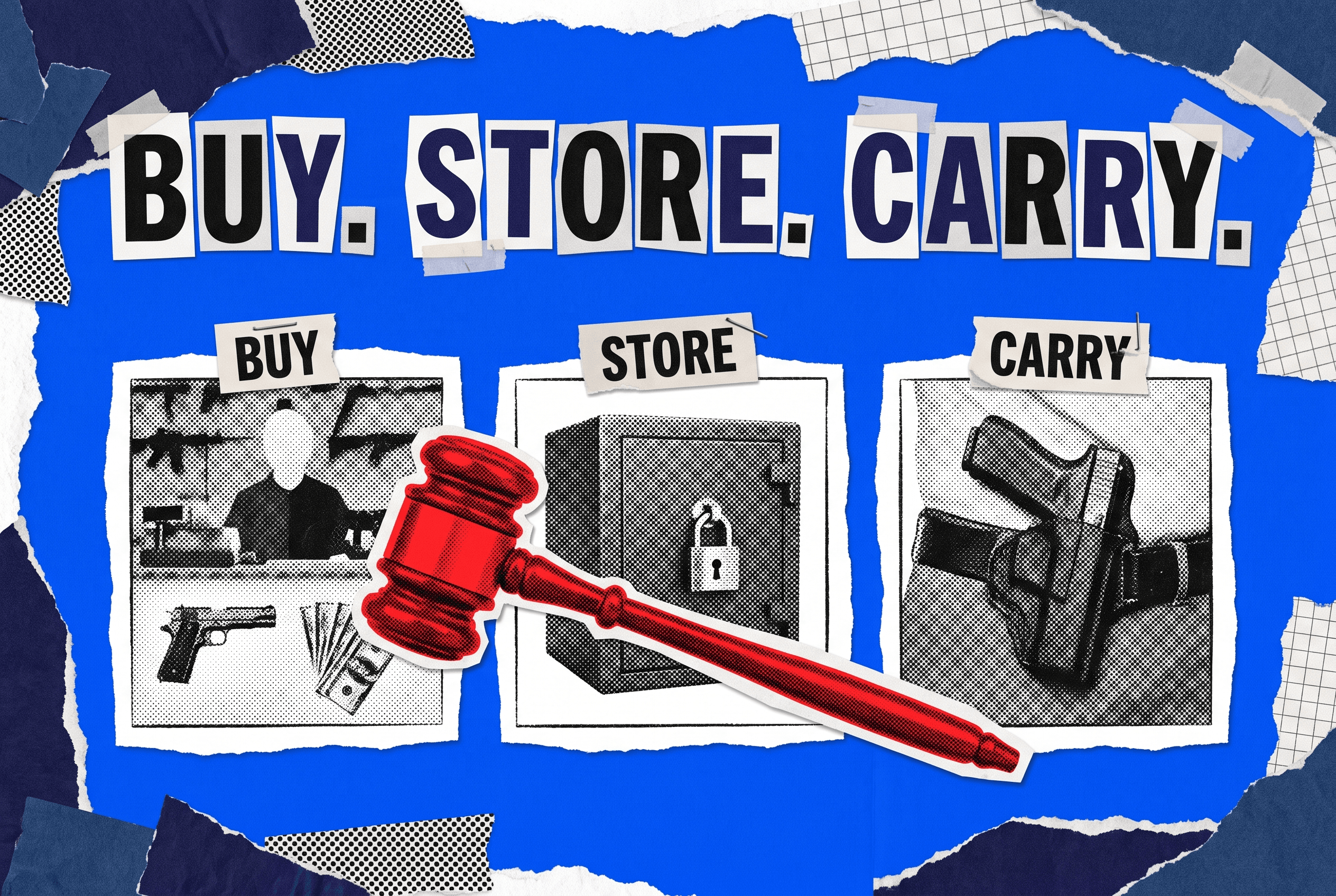
Gun law sits in four layers, federal, state, local, and wherever you physically are, and most first-time buyers only deal with the first two.
The reason this feels impossible to research is that everything you read seems to contradict something else you read. One page says one thing, a forum says the opposite, and both are probably correct for the place they were written about.
That's the actual problem, and it's a sorting problem more than a knowledge one. Once you can tell which layer a question belongs to, finding the answer stops being difficult. American Gun Owners handles the sorting on the buying side, and this page is the map for everything after it. If you're at the very start, our plain-English checklist for buying your first gun covers the practical side.
Key takeaways
-
Four layers of law apply, and buying from a licensed dealer engages mostly the federal one.
-
State law does the heaviest lifting on storage, carry, and transport.
-
Local ordinances exist and are the layer people most often forget to check.
-
The rules follow where the firearm physically is, not where you live.
-
Most of the complexity people have heard about is concentrated in carrying and in crossing state lines.
The short version
-
Federal. Who may buy and possess, and how a dealer transfer works. Broadly the same everywhere.
-
State. Storage, carry, transport, permits, and anything added on top of the federal floor.
-
Local. City or county ordinances, often about discharge and public carry.
-
Situational. The law of wherever the firearm is right now, which is why a drive can change the answer.
Which gun laws actually apply to you?
Four layers apply: federal law, your state's law, local ordinances, and the law of wherever the firearm physically is at the time. They stack rather than replace each other, so more than one can be relevant to the same question at once.
That stacking is not an accident of drafting. Federal firearms law says so about itself: section 927 of Title 18 states that no provision of the chapter should be read as Congress intending to occupy the field to the exclusion of state law, unless the two are in direct conflict and cannot stand together. In plain terms, the federal layer deliberately leaves room for states to add on top. That single sentence is why two sources can describe the same situation differently and both be correct about the place each one is describing, and it is the thing that makes the confusion feel like contradiction when it isn't.
For most first-time owners the practical answer is narrower than that sounds. Buying from a dealer, taking the firearm home, and keeping it there engages the federal layer and your own state's, and that's usually the whole picture. The fourth layer only becomes interesting when the firearm starts moving.
Most of what people have half-heard about gun law is about carrying, not about owning, which is why the research feels more alarming than the reality of a first purchase turns out to be. The four layers below are the sort itself, and each one names where its answers actually live instead of holding them on this page.
The four layers
Each layer governs different things, and knowing which one your question belongs to is most of the work. The table below is a map rather than an answer key: it tells you where to look, not what you'll find.
| Layer | What it typically governs | Where to check it |
|---|---|---|
| Federal | Who is eligible to buy and possess, how a licensed dealer transfer works, and the paperwork that goes with it | Federal statute and the ATF. Broadly consistent nationwide |
| State | Storage requirements, carry permits, transport rules, and anything a state adds above the federal floor | Your state's own statutes, and often a state police or attorney general page |
| Local | City or county ordinances, commonly covering discharge and carry in public spaces | Municipal code for the city or county, which is the layer most often missed |
| Situational | The law of wherever the firearm physically is at that moment, including a vehicle in transit | The rules of each jurisdiction you are in or passing through |
The fourth layer is the one nobody names, and it's the source of most genuine confusion. It's why the correct answer can change during a car journey without anything about you changing at all. That journey has a page of its own: our guide to transporting your firearm covers what the road actually requires.
What applies when you buy
Buying from a licensed dealer is the most federally standardized thing you'll do, which is why the process looks broadly the same wherever you are. That consistency is the reason a first purchase is usually the least complicated part of ownership.
Two categories of federal question govern it: whether you're eligible to buy, and what the transfer itself involves. Both are well-defined and both are handled at the counter, not by you in advance. They also live somewhere specific, which is worth knowing even if you never read a line of it: the federal statute the counter process is built around is section 922 of Title 18, and the regulations sitting beneath it are in part 478 of Title 27 of the federal regulations. The useful thing is not to memorize either one. It is to recognize that this is the layer a dealer is working from when they ask you something, so an answer you find online that never says which layer it came from has not actually answered you yet. States can add requirements on top, which is where permits and waiting periods come from, and those vary considerably.
For the eligibility side, our guide to whether you need a background check covers the federal position. For the paperwork, our walkthrough of ATF Form 4473 goes box by box.
What applies when you store it at home
Storage is mostly state territory, and a minority of states set specific requirements, particularly for households with minors. The federal layer says comparatively little here, which is why storage advice varies so much between sources.
That means two things practically. First, a general article can tell you what good storage looks like but can't tell you what your state requires, so both are worth knowing separately. Second, this is a category where the answer genuinely does change at a state line, so guidance you find from someone in another state may not describe your obligations. The practical consequence is that storage is the topic where borrowed advice goes wrong most quietly. A thorough, well-written guide written by someone two states away can be entirely accurate for them and simply not describe what applies to you, and nothing in it will flag that, because the author had no reason to think about where you live. Read storage guidance for the technique and your own state's statutes for the obligation, and keep the two apart in your head.
Our guide to storing a gun at home covers the practical side, and your state's own statutes cover the required side.
What changes when you carry or travel?
Carrying and crossing state lines are where the layers stop agreeing with each other, and where most of the complexity people have heard about lives. This is the honest answer to why gun law has the reputation it does.
Carry brings in permits, reciprocity between states, and location-based restrictions that can operate at all four layers at once. Travel brings in the situational layer directly, because the applicable rules change as you move rather than staying fixed to your home address. Neither is unmanageable, and both need checking in advance, never assumed. Reciprocity is the part that surprises people most. A permit is issued by one state and recognized by others only to the extent those states choose to recognize it, so the same document in the same wallet can be valid on one side of a line and not the other, and the arrangements change as states revise them. That makes it a thing to check close to a trip rather than once and remember.
Our explainer on open carry, concealed carry, and constitutional carry covers the carry systems, and the transport guide linked above covers the travel side.
How do you check your own state?
Work down four questions in order, and each one points at a specific source rather than a general search. This is the part that turns an unbounded research problem into a short list. The order matters more than it looks. Starting from where the firearm will physically be, rather than from a general search, turns a question with fifty possible answers into one with a single jurisdiction attached to it. That is the difference between research that finishes and research that just keeps going.
| Ask | Which layer it belongs to | Where the answer lives |
|---|---|---|
| Where will the firearm be bought and transferred? | Federal, plus that state's additions | The dealer, who does this daily, and that state's statutes |
| Where will it normally live? | State, and sometimes local | State statutes on storage; municipal code for your city or county |
| Will it leave that address? | State and situational | State transport rules for each state involved |
| Will it cross a state line? | Situational, plus federal transport provisions | The rules of every state on the route, not only origin and destination |
Two shortcuts worth knowing. A licensed dealer answers the first question for a living and will tell you plainly. And for anything specific to your own circumstances, an attorney is the right destination rather than a forum, because that's the question a general page structurally can't answer.
Getting the compliance part handled for you
The buying layer is the one that can be taken off your list entirely, and that's the part American Gun Owners handles. You give your location up front, and the catalog you see is filtered to what's available where you are, so the research step that trips people up doesn't come up.
That removes a step. It does not remove the topic. Storage, carry, and travel are still yours to check, and this page is the map for doing that. What it means is that the first purchase, which is where most people expect trouble, is the part you don't have to research.
If you'd rather start from where you live than from a catalog, the Find My Gun Kit quiz begins with your zip code.
Frequently Asked Questions
Do federal or state gun laws take priority?
In practice you comply with both. Federal law sets a baseline that applies nationwide, and states can add requirements above it, which is why a state can require something federal law doesn't mention. The practical effect for an owner is that the stricter of the two is the one that governs your situation.
Do gun laws change when you cross a state line?
Yes, and this is the single most important thing to know before traveling. The applicable rules follow where the firearm physically is, so they can change several times on a long drive. Checking every state on a route, rather than only the origin and destination, is the standard advice for exactly this reason.
Are gun laws different in cities?
They can be. Local ordinances are a real layer and commonly cover things like discharge within city limits and carry in specific public places. How much power a city has to add rules varies by state, so this is a layer to check, not one to assume, particularly if you live in or travel through a large metro area.
Do you need to know the law to buy from a dealer?
Not in advance. The dealer handles the transfer requirements and will tell you what's needed at the counter, which is a large part of what a licensed dealer is for. Knowing the categories helps you ask better questions, but nobody expects a first-time buyer to arrive having researched the statutes.
Where can you get an answer about your own situation?
For anything about buying and transfer, a licensed dealer is the fastest reliable source and deals with these questions constantly. For anything turning on your specific circumstances, particularly if something in your history might matter, an attorney is the right destination. A general article can describe the categories; it can't apply them to you.
Sources
-
18 U.S.C. section 927, effect on State law, Cornell Law School Legal Information Institute: law.cornell.edu
-
18 U.S.C. section 922, unlawful acts, Cornell Law School Legal Information Institute: law.cornell.edu
-
27 CFR part 478, commerce in firearms and ammunition, Electronic Code of Federal Regulations: ecfr.gov
Related
We strive to provide accurate, up-to-date information to help first-time firearm owners make informed decisions. Because laws and regulations vary and may change, always verify the requirements that apply to your location and follow safe firearm handling practices.